
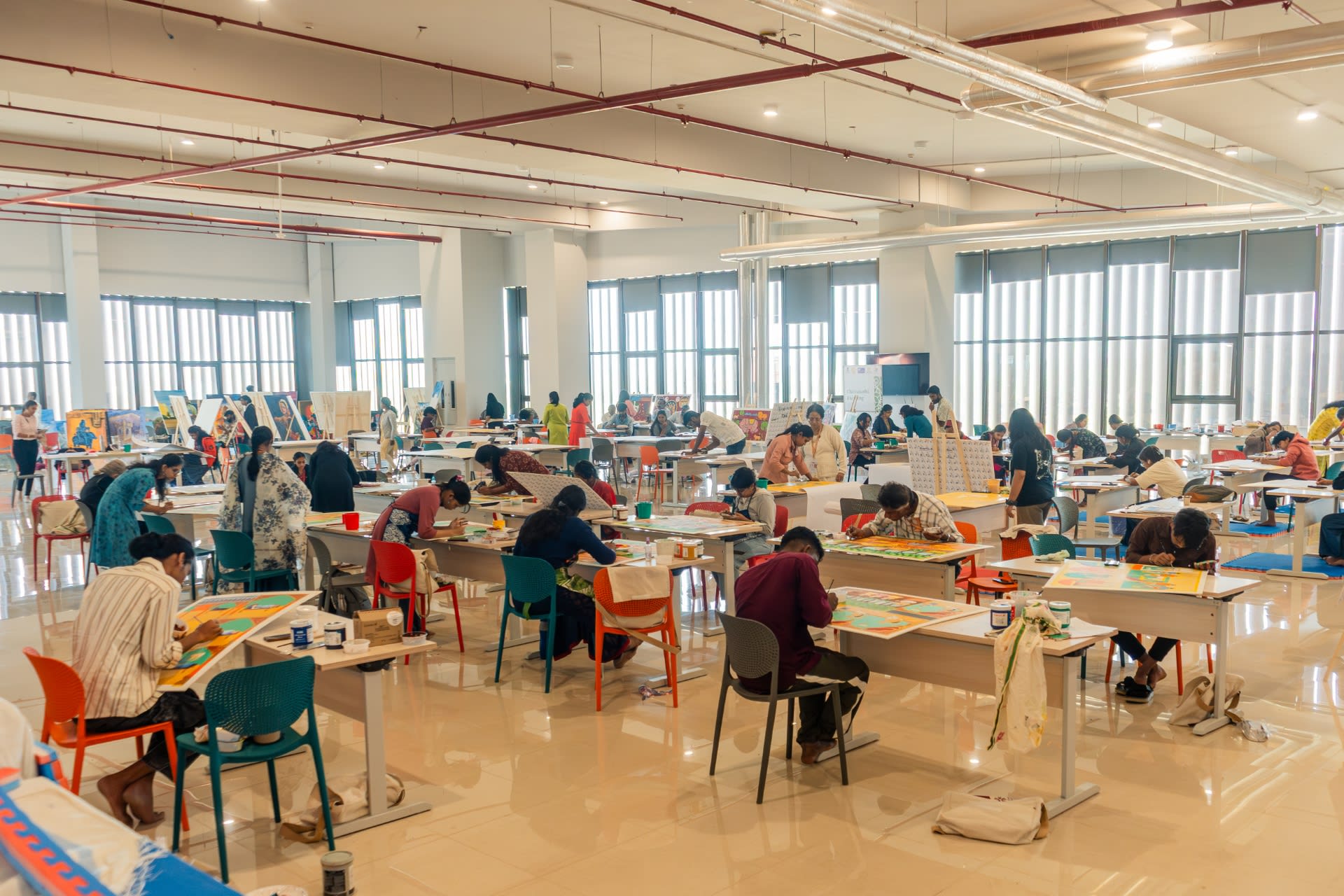

The National Art Camp on Indian Art was conceived as a large-scale initiative to explore, interpret, and visually document India’s rich artistic traditions through the timeless stories of the Panchatantra. Held from 28 January to 27 February 2026 at Chanakya University, Bengaluru, the camp brought together artists, art educators, students, and young practitioners from across the country, creating a shared platform for artistic exchange, cultural learning, and creative collaboration.
Being entrusted with the role of Creative Director was a unique opportunity to contribute to a project of this scale. The initiative was organised by Art Matters, a forum of Yuvaka Sangha, in collaboration with the Indian Knowledge Systems (IKS) Division, Ministry of Education, Government of India, and Chanakya University. The project brought together 10 Indian art forms, through which 84 Panchatantra stories were interpreted visually, resulting in 840 artworks. The scale of participation was equally remarkable, with 10 Chief Artists, 30 Associate Artists, and more than 350 students and young artists representing 17 states and 49 Visual Art and Design colleges.
A significant part of the creative process began before the main camp. A one-week residential pre-camp workshop was organised for the Chief Artists and Associate Artists. This phase was designed to establish a strong creative foundation before the larger group of students and young artists joined the process. The Panchatantra stories were narrated and discussed, allowing the artists to understand the narratives, characters, situations, symbolism, and underlying ideas.
The artists then moved through a structured process of ideation, preliminary sketches, visual exploration, and final drawing. This preparation was particularly important because the final drawings developed during the pre-camp became the creative foundation for the participating young artists. Instead of beginning the interpretation from scratch, the students could directly transform the prepared drawings into artworks within their respective traditional art forms. This approach helped maintain consistency in the storytelling while allowing the young artists to engage deeply with the techniques and visual language of each art form.
At the heart of the project was the challenge of bringing together India's diverse artistic traditions within a common creative framework. The participating art forms represented different regions, histories, techniques, materials, and visual languages. Each had its own identity, and finding ways to retain that individuality while creating a cohesive body of work was one of the most rewarding aspects of the journey.
The Panchatantra provided an especially fascinating foundation for the project. Its stories have travelled across generations and geographical boundaries, carrying ideas about human behavior, relationships, wisdom, ethics, strategy, and everyday life. Translating these narratives into visual forms required the artists to look at familiar stories from new perspectives and discover possibilities within them.
One of the most meaningful experiences was working with artists from different generations and backgrounds. The Chief Artists brought their experience and knowledge of traditional practices, the Associate Artists supported the creative development and execution, while the students and young artists brought curiosity, experimentation, and fresh interpretations. The interaction between these groups created a valuable environment of mentorship and learning.
The residential nature of the camp strengthened this exchange. Conversations did not remain limited to the studio or scheduled sessions. Artists and students shared ideas, discussed techniques, observed one another's working processes, and learned through informal interactions. These moments often became as important as the formal creative activities.
The scale of the project also brought considerable responsibility. Coordinating multiple art forms, artists, participants, timelines, creative requirements, and practical challenges required continuous communication and adaptability. There were moments when plans had to change, problems had to be solved immediately, and decisions had to be taken with the larger vision of the project in mind.
Through this experience, I came to understand even more deeply that traditional Indian art is not simply a collection of styles or techniques. Every art form carries histories, memories, community knowledge, materials, symbols, and ways of seeing the world. Working with these traditions demands respect for their roots while also allowing space for contemporary interpretation.
The project also became an exercise in cultural documentation. Each artwork represented an individual interpretation, but together the 840 artworks created a much larger visual archive of the Panchatantra through Indian artistic traditions. The project demonstrated how storytelling and visual art can work together to preserve cultural knowledge while making it accessible to new generations.
I am especially grateful to Prof. Bharat Dash, Chief Story Narrator, and Prof. R. H. Kulkarni, Chief Artistic Mentor, for their guidance throughout the process. Their perspectives and engagement added depth to the creative journey.
My heartfelt thanks go to all 10 Chief Artists and 30 Associate Artists, whose knowledge, commitment, patience, and artistic dedication shaped the project. I am equally grateful to all the 350+ students and young artists who participated with enthusiasm and openness to learning. Their energy, curiosity, and willingness to experiment gave the camp its spirit.
I would also like to acknowledge Indian Knowledge Systems Division, Ministry of Education, Govt. of India. Art Matters, Yuvaka Sangha, Chanakya University, and the wider coordinating, academic, administrative, production, logistics, and support teams. A project of this scale can never be the achievement of one person or one department. It is the result of countless conversations, preparations, corrections, collaborations, and contributions that often remain behind the final artworks.
Looking back, the National Art Camp on Indian Art was much more than a project for me. It was a journey of collaboration, learning, leadership, and cultural discovery. It gave me an opportunity to work with diverse artistic traditions, meet remarkable artists and young practitioners, and witness how stories can bring people together through art.
Above all, the experience reaffirmed my belief that art can serve as a bridge between heritage and contemporary generations. When knowledge is shared, traditions are practiced, and young minds are given the opportunity to interpret them creatively, culture does not remain confined to the past—it continues to live, evolve, and find new voices.